
Travel & Other Activities
Apart from astronomy, I have a number of other hobbies including travel, photography, scientific experiments, amateur radio, computers, etc. If you are interested, feel free to browse...
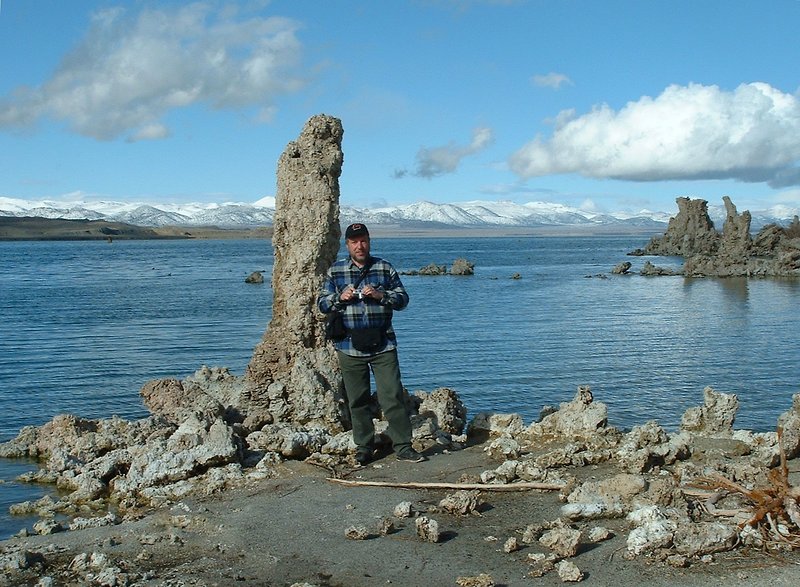 |
Author posing in front of a Tufa Column, Mono Lake, California, 2004
Click here to learn more about my trips to the USA.
Click here to see my photos from a Namibia trip in 2008.
Click here to see my photos from a Scotland trip in 2009.
Click here to see my photos from a France trip in 2011.
Click here to see my photos from a Copenhagen trip in 2012.
Click here to see my photos from a Canada trip in 2012.
Click here to see my photos from a trip to Andalusia in 2013.
Click here to see my photos from an England trip in 2015.
Click here to see my photos from several trips to the Canary Islands between 2015 and 2023.
Click here to see my photos from a Canada trip in 2016.
Click here to see my photos from a trip to Eastern Europe in 2018.
Click here to see my photos from a Norway/Sweden trip in 2022.
Click here to see my photos from a Portugal trip in 2024.
Here are some examples of my other activities:
High Voltage and X-Ray Experiments
Why this web site is powered by  :
:
After using Microsoft products for many years, I was fed up with this company's arrogance and rude business conduct, for example their outrageous licensing policy,
their inescapable Windows bundled with almost any new PC, application programs inseparably merged with the operating system, "updated" file formats incompatible with
older versions of the same software, old and inefficient technology under a shiny surface, etc., etc. These people do not show the slightest respect for their
customers, and their business strategy is similar to that of a drug dealer: making people as dependent as possible in order to drain them dry.
So I started looking for alternatives. The idea of buying a Mac was abandoned very soon because the people from Apple pursue a similar (if not worse) strategy.
Obviously, the marketing guys from Apple successfully manipulated many consumers into thinking that an overpriced Mac/iPhone/iPad is a "lifestyle product", i.e.,
something prestigious you must have to demonstrate your social status (I am perfectly happy with my social status, so I don't have to prove anything). Out of
curiosity I played around with a Mac at a local dealer's store, but apart from an admittedly nice design I found nothing really exciting about it. People who think
they absolutely need something stylish may get happy with it.
I have become immune to marketing talk. This is because I had to cooperate with marketing people for many years and, as a result, consider the majority of them
as a parasitic life form now. So the idea of trying open-source operating systems and software more or less suggested itself. Soon I discovered the potential of
Linux. After testing it for a couple of weeks, I was fully convinced of its functionality, and I decided to ban Windows and the related software from all PCs (3) and
laptops (2) in my home network. The complete switch to Linux came in 2007, and I never regretted it. In summary, my wife and I can do everything we did before:
write, calculate, draw, make presentations, exchange files, surf the web, read and write e-mails, make phone calls, send and receive faxes, view and process photos
(including RAW files), scan, print, listen to music, watch and edit videos, watch and record TV, etc. There is a world beyond Microsoft and Apple!
Many people shy away from Linux because they believe it is for experts only. Nothing could be farther from the truth. Although Linux is an extremely powerful
operating system, learning how to install and use it is a matter of hours or days (if you own a smartphone not coming from Apple, there is a good chance you are
using a Linux derivative already). Modern Linux distributions come with appealing graphical user interfaces (you can choose between Gnome, KDE, Unity, Mate,
Cinnamon, XFCE, LXDE, and others) and are easy to operate. Believe it or not, you can run Linux without ever touching the command line (I actually use it quite
often now after I learned to appreciate its benefits)! Using Linux is fun! There is a wide range of excellent open-source application software available for almost
any task one can think of. Installing and uninstalling software is an automated process in most cases. All you have to do is start a "package manager". A list
with a huge number of applications, sorted by categories, will appear. After selecting the desired application by mouse click, Linux downloads the program files,
called "package", from a server and installs the application. To uninstall the program, go to the same list and deselect it. Linux does the rest. Incredibly easy!
You can even run many Windows programs under Linux through Wine.
Hardware support has improved considerably in recent years, so many printers and scanners work "out of the box". If in doubt, one can look at the hardware
compatibility lists available for most Linux distributions. It should be mentioned, however, that some hardware manufacturers stubbornly refuse to cooperate
with the Linux community and that many vendors simply ignore the existence of operating systems not coming from Microsoft or Apple (guess why).
Linux comes in many varieties, so a newcomer might get confused easily. I personally prefer Debian since it is a rock-solid,
dependable workhorse (I need my PC primarily to get things done and can live without much eye-candy).
Ubuntu and Mint are very popular distributions too. They are a little more shiny than
Debian and need very little manual configuration. Particularly Mint has a very polished look-and-feel and comes with preinstalled multimedia codecs, so it is
probably the best choice for newbies coming from the Windows world. All three distributions have good hardware support. People working in a professional
environment may prefer OpenSuse (backed by Novell). Mandriva and Fedora are excellent as well. Die-hard purists will prefer Arch Linux, Slackware, or Gentoo.
There is something for almost every taste.
Most Linux versions run very well even on older computers since they are not very resource-hungry, so you don't have to buy new hardware every time a new version
is released. Linux is extremely configurable. Everybody can customize it to his/her taste (you can even make it look like Mac OS if you like). Last but not least,
Linux is very stable and much less vulnerable to virus and malware attacks than Windows. Therefore it is not necessary to run virus and malware scanners in the
background all the time (slowing down the system).
Don't trust companies spending more money on advertising, lobbying, bribery, and legal actions than on technical innovation and quality management. Don't support
people who prefer bullying competitors and customers rather than taking up the challenge of fair competition. Don't let quasi-monopolists and their vassals decide
what is good for you (and, of course, for their own pockets). There are alternatives. Instead of wasting your money for overexpensive products, go to
Distrowatch, read the test reports, download the iso image of a popular Linux distribution, burn an installation
CD*, and try it out. It won't cost you a penny. Spend your hard-earned money elsewhere and enjoy your new freedom!
*Some distributions, e.g., Ubuntu and Mint, come as a bootable "Live CD" which enables you to test the operating system without writing anything to the hard drive before installing it permanently.
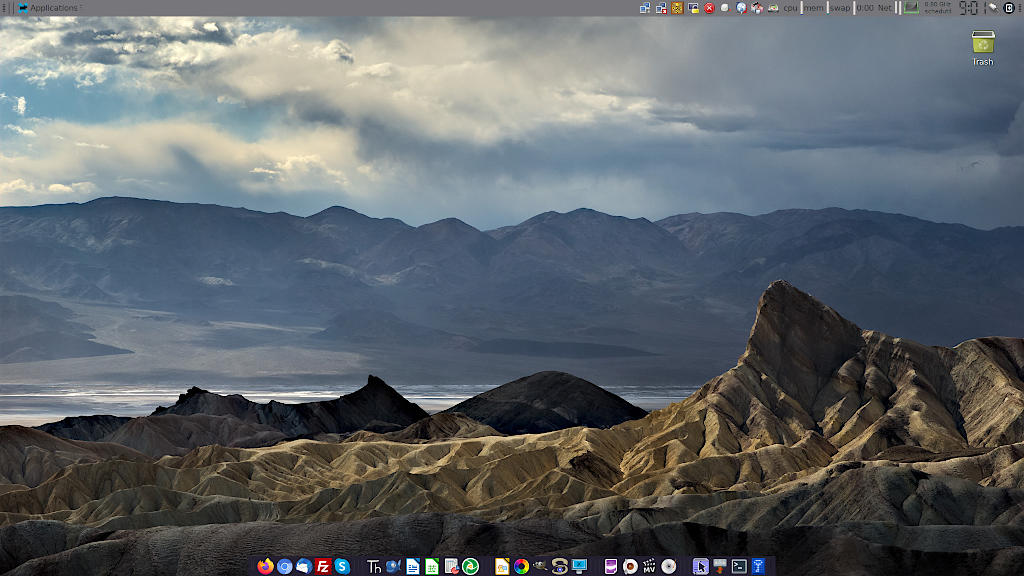 |
My Debian Desktop (with XFCE)

